
Called Incubator.edu, the program began in the 2020-2021 school year under the direction of Jenny Breuer, whose commitment and genuine passion led to the success of the program and the students she inspired. “This program got off the ground because of Jenny’s genius and perseverance. So many kids (and mentors!) have benefited because of her dedication,” noted Sharon Ramey, a mentor for the program. “I love that Jenny starts with ‘find a problem’ … then moves onto ‘find a solution for that problem’ … then ‘could you create a business around solving that problem?’: i.e. ‘do others have that problem and would they be willing to pay you for a solution?’ Wow, what would this world be like if kids were taught that within every problem, there’s a wonderful solution?” suggested Ramey.
Breuer retired at the end of this school year and passed the torch to Dalton Fraley who explained in detail how the program works. Unlike many specialized academic tracks, the business and entrepreneurship pathway requires no formal application. Any student with curiosity and initiative can join. In fact, many Boerne High students travel regularly for class, and transportation has never been a barrier. Participants move through four courses — Intro to Business, Entrepreneurship I, Entrepreneurship II and finally Business Practicum, a work/study experience that places students directly in the world they’re preparing to enter.
A Year of Transformation
Students rarely enter the program with a polished business idea or the confidence to pitch it. Most arrive unsure of how to handle failure or how to speak with authority in front of a room. Those two skills become the program’s first priorities. “We want them to learn to fail fast and not treat it as the end of the world, and we want them to be able to walk into any room and command it,” said Fraley.
Alongside these foundational skills, they gain something many adults never do: the ability to build something from scratch and the insight to know when a recalibration is needed. “When you discover that your potential customers don’t like your solution as much as you thought they would, then you don’t have to keep it — you can pivot, make changes or go in an entirely different direction,” explained Ramey.
The growth students experience is profound. They begin with a vague idea and end the year with a functioning prototype, real-world testing under their belt, and a polished 10-minute pitch delivered on stage. “Watching that transformation happen over the course of a school year is one of the most rewarding things about teaching this program. The growth is honestly hard to overstate,” Fraley shared.
A Startup Journey, Step by Step
To begin, teams are formed based on business interests, working styles, compatibility and shared vision. Fraley expanded, “We also ask them directly who they work well with and who they do not. Real business partnerships live or die on the people involved, so we take this part seriously.”
Students then brainstorm and refine their ideas to pitch to mentors on Mentor Match Day. From there, they compete for seed money, build prototypes, test them, gather feedback and keep refining until their final pitch and presentation. This isn’t theoretical learning. It’s the real entrepreneurial process, lived out over the course of a school year.
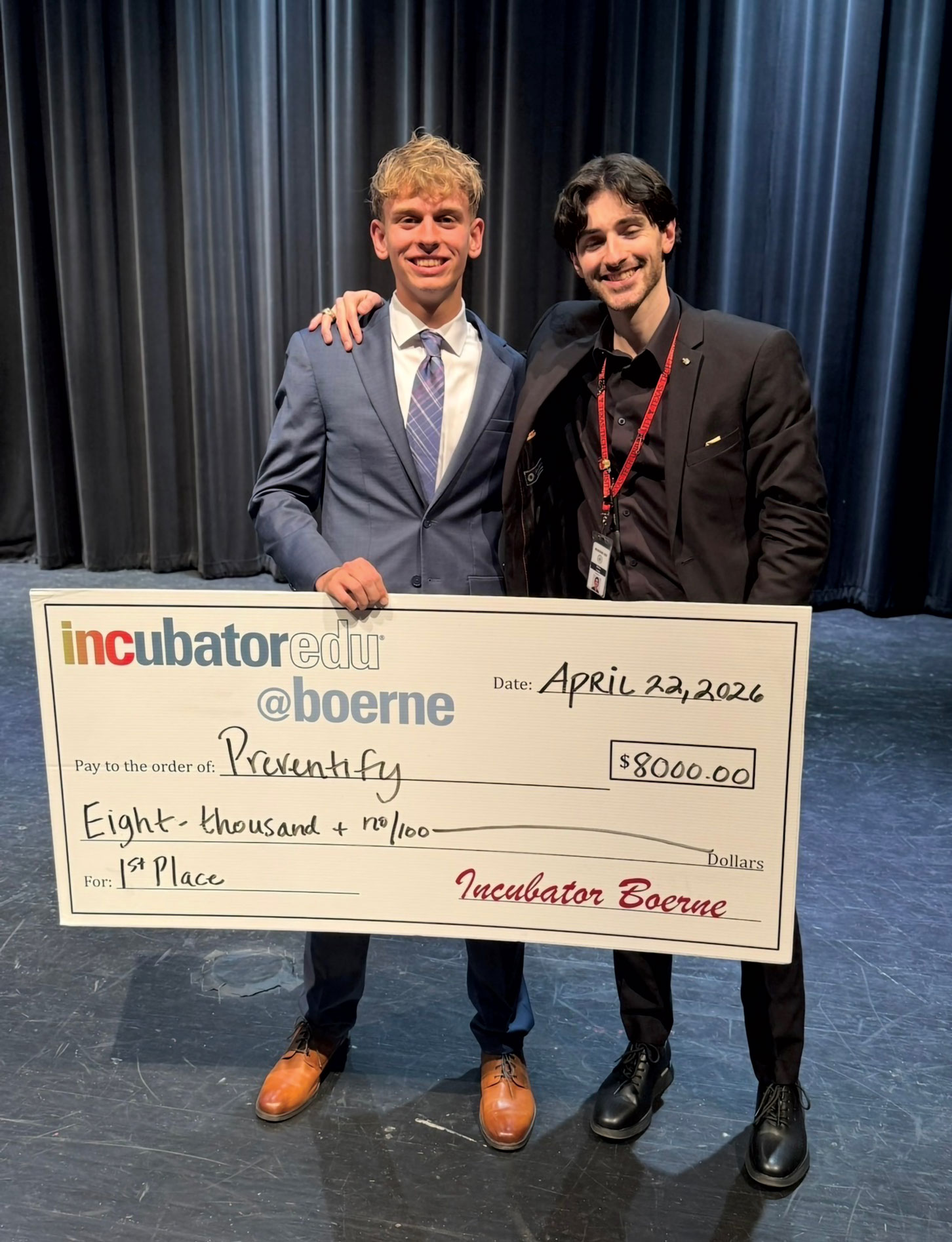
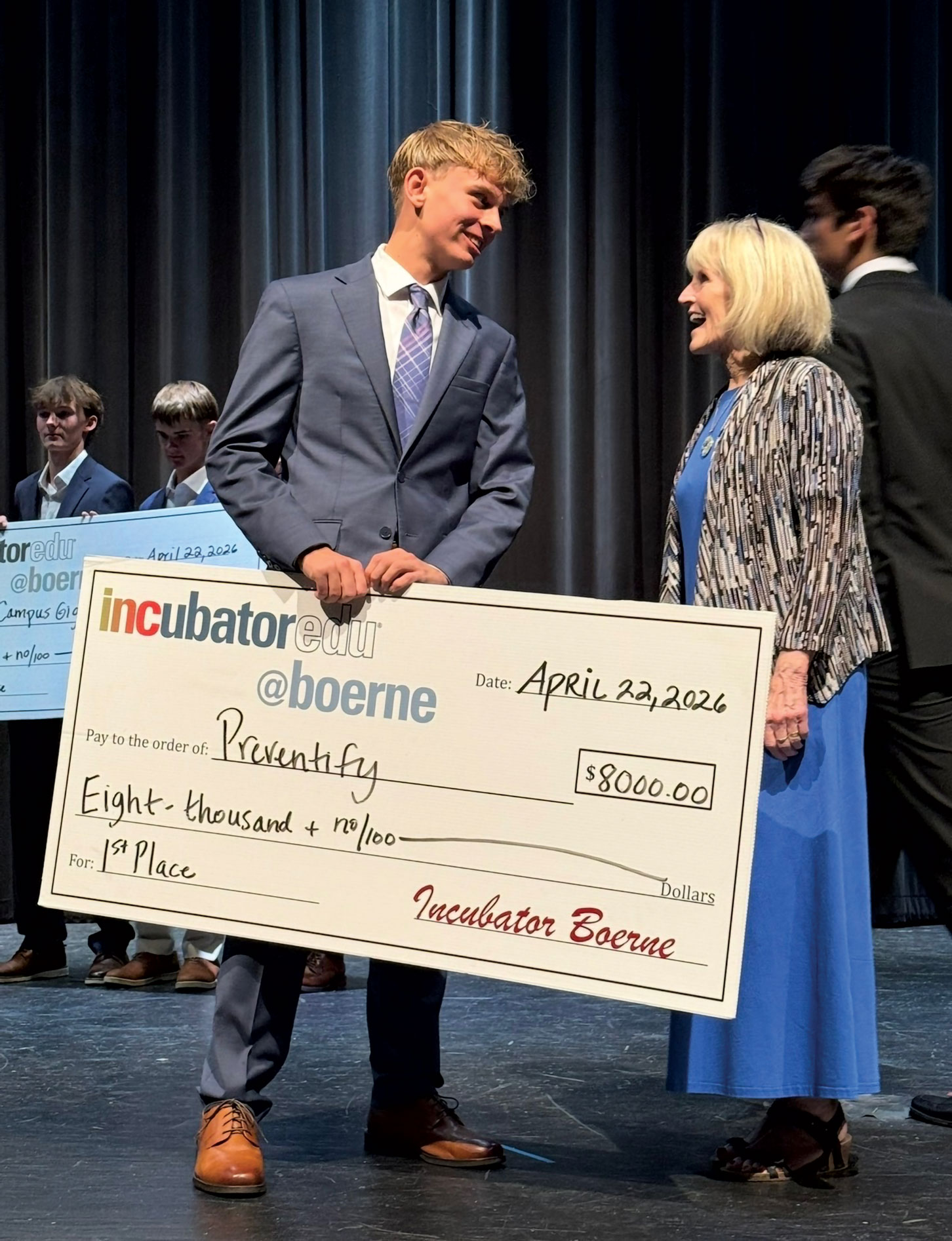
For Owen Labay, this year’s First Place winner at Pitch Night, his path was a little unconventional but not without lessons learned. Owen entered the program and was matched with mentor Sharon Ramey after the class was well underway, but he had a specific product already in mind and a desire to be a solo entrepreneur. “My idea was an injury prevention app called Preventify, designed specifically for tennis players. I was passionate about this project because I had experienced injuries myself, which led to lost opportunities and a frustrating rehabilitation process. Over time, through the Incubator class, I expanded the concept into a functioning app built around preventative training programs across multiple sports,” he explained. This included collaboration with experts across multiple disciplines, and months researching, testing and refining the app designed to equip athletes with sport-specific training plans, demonstration videos and adaptive programs that adjust based on their daily check-ins.
Ramey praised Owen’s determination, in the midst of being a competitive tennis player and an advanced student. “He would jump at any chance …. practicing and practicing until he felt confident. And I’m convinced that’s what creates winners. He made it all the way to the top 11 Incubator contestants in the Nation!” she said.
“Ms. Ramey consistently pushed me out of my comfort zone, which made a real difference in my confidence. She taught me how to carry myself as a professional and as someone with integrity, while also giving me extensive feedback on my pitch and business. Beyond the Incubator class, she showed me the importance of kindness, professionalism and giving back to the community,” said Owen who also recognized Mr. Fraley equally for his support.
As for going solo, Owen said that from the experience he gained the skills to present himself effectively and problem-solve with confidence, but added,” I learned that building a successful company can never really be a solo effort. With the help of mentors, teachers, physical therapists, app developers and other professionals, I was able to take this idea further than I ever could have imagined. This experience taught me firsthand that it is okay to not have every answer, as long as you are willing to learn from the people around you.”
The experience also shifted the trajectory of his college goals. Owen said, “Before joining the program, I had some interest in becoming a physical therapist, but the Incubator showed me how much I actually enjoy entrepreneurship. The class gave me the confidence that this is something I can genuinely pursue as a career, and I plan to focus on business going forward.” He plans on using his $8,000 award to further develop Preventify.
Strengthening the Program’s Impact
Mentors are the heartbeat of the program. “The best mentors are the ones who genuinely want to invest in young people and can meet students where they are. Patience is huge because these are high schoolers working through real problems for the first time. Someone who has built something themselves and can speak honestly about the messy middle of that process tends to connect with students the most,” noted Fraley.
Students connect with mentors during Mentor Match Day at Das Greenhaus, an energetic, speeddating-style event where students pitch their ideas and mentors choose teams they feel inspired to support.
“Mentors can’t do the work for their teams. We can be available to guide and help them, but we can’t make them do well. They have to really want to go beyond what’s expected to be successful. It’s the same in growing a real business. Entrepreneurship isn’t for everyone. It requires a lot of extra work. If students have the drive and work ethic to do well in the class and the competition, they will. If they don’t, they won’t,” said May McCarthy, a Cordillera Ranch resident who has mentored teams at the university level and young companies as an Angel Investor since the early 2000s. “About four years ago, my sister Sharon Ramey asked me to meet with her high school team to help them with financials and presentation skills. It was fun, so I continued to help in subsequent years,” McCarthy added, who began as a subject matter expert before assuming the role of mentor. McCarthy’s 2025 DOZE APPAREL team won the Incubator competition and received the fan favorite award at Texas A&M during the Texas High School Ideas Challenge.
To expand the program’s reach, more involvement from the business community is key. “There are a few different ways to do that depending on how much time you have. Team mentors work closely with one student team throughout the year. Team co-mentors support a team in a secondary role with a lighter time commitment. Coaches come in to work with the whole class or specific groups at key points in the year. And judges are needed for our pitch competitions,” Fraley explained.
A DistrictWide Vision
The vision has always been clear: any student with the drive to build, create, and innovate should have the opportunity to do so. For those interested in supporting the program financially or through resources, the door is open. Community members can contact Mr. Dalton Fraley at dalton.fraley@boerneisd.net to explore opportunities.