
By:
David Edgar, Director of Racquet Sports
A dominant net game is a core foundation of high-level pickleball. Mastering Kitchen positioning, dinking, volleying and pace control allows you to dictate rallies, pressure your opponents, and create high percentage scoring opportunities. The following tips will help develop the skills and strategy needed to take control of the Non-Volley Zone and become a more confident player.
Proper Positioning
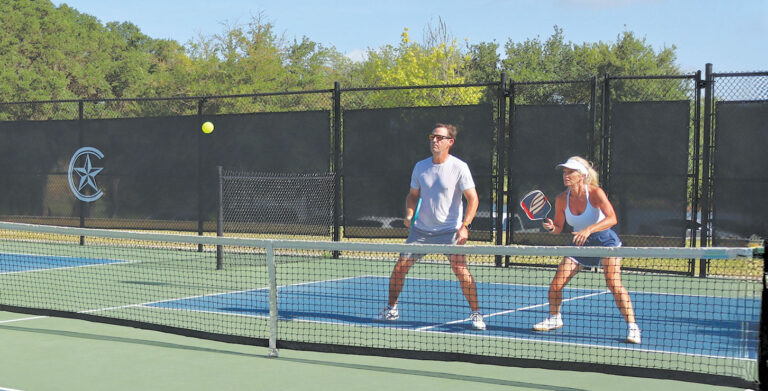
Controlling the Non-Volley Zone (NVZ) or “Kitchen,” allows you to dictate the tempo of the rally and set up aggressive finishes. Positioning yourself right at the NVZ line enables higher volley contact points, turning defensive situations into offensive opportunities.
- The Athletic Ready Position: Drop your center of gravity by bending your knees — aiming to lower your stance to about two-thirds of your full height, with your feet wider that shoulder-width apart.
- Paddle Up and Track: Keep your paddle face out in front at chest level, ready to react instantaneously to high-velocity drives. Slightly point the paddle towards the direction of the incoming shot and make the reaction time easier by tracking the next shot with your paddle.
Become a Master Dinker
The dink is a soft, controlled shot landing inside the opponents NVZ, designed to neutralize aggressive play and force errors. Dinking is essential when the ball drops below net height, preventing you from over-hitting into an opponent’s attack zone. The key is to try to make the opponent uncomfortable, through the use of creative touch and spin.
- Strategic Variety: Vary your dink placement (cross-court, down-the-line, and at the feet) and apply subtle topspin or underspin to keep opponents off balance.
- Targeting Weaknesses: Dynamic dinking forces your opponents to stretch and move, exposing gaps in their coverage and increasing the likelihood of a high return.
Volley with Purpose
Volleying takes away our opponent’s reaction time by eliminating the bounce. Hitting the ball out of the air keeps the pressure on and prevents the opposing team from resetting their position. As always, good positioning close to the NVZ line helps us to optimize the height of the incoming shot, and reduces the chances of dumping the volley in the net.
- Deep Volleys: Aim deep into the backcourt to push opponents away from the NVZ, opening up space in front of them and granting your team extra time to set up.
- Angled Volleys & Attack Volleys: Direct punch volleys toward your opponent’s hip or off-hand shoulder to cramp their stroke, or carve sharp angles into open space to force out-of-bounds stretches.
Control the Pace and Reset the Point
Power alone rarely wins matches at higher levels; precision and patience do. Being able to absorb an opponent’s hard drive and drop it softly back into their Kitchen, known as a reset, instantly takes the offense away from them.
- Soft Hands: Relax your grip pressure (aim for a 3 or 4 out of 10) to absorb incoming pace rather than redirecting it back first.
- Patience Drill: Practice continuous cross-court dinking rallies with a partner, intentionally focusing on unhurried placement and consistent arc over the net.
Force the Pop-Up and Attack
The ultimate goal of patient dinking, purposeful volleying and pace control is forcing your opponent into a mistake: a high, weak bounce or lift known as a “pop-up.” This is when you can shift from neutral to offense.
- Recognize the Lift: Train your eyes to identify when an opponent is off-balance or striking the ball well below net level, as this almost always results in an upward trajectory.
- The Put-Away: When the pop-up comes, do not rush. Transfer your weight forward, keep your wrist firm, and hit smoothly down into the open court or directly at your opponent’s feet to close out the point.
Mastering these court positioning, control and shot-selection fundamentals transforms your net play from reactive to dictational. By combining aggressive stance at the Kitchen line with soft touch and disciplined patience, you force opponents out of their comfort zone and turn high-percentage opportunities into match-winning points. Stay committed to controlling the pace, trust the process of setting up the pop-up, and you will consistently be dominate at the net.
David Edgar is the Director of Racquet Sports at The Clubs of Cordillera Ranch. He can be reached at 830.336.9181 and dedgar@cordilleraranch.com.